Introduction
Your first orthodontic visit is a comprehensive welcome to the treatment journey. You’ll begin with paperwork to gather medical and dental history, followed by a thorough clinical exam. The orthodontist will use digital X‑rays, intra‑oral photographs, and 3‑D scans to evaluate tooth position, bite, and jaw alignment. These diagnostic records allow the clinician to create a personalized treatment plan that outlines the recommended appliance—whether traditional braces or clear aligners—estimated duration, cost, and any necessary preparatory steps such as treating cavities or gum disease. Personalized care matters because each mouth is unique; factors like age, growth stage, lifestyle, and aesthetic goals influence appliance selection, force levels, and timing. By tailoring the plan to your specific needs, the practice ensures optimal comfort, efficient tooth movement, and the best possible long‑term outcome.
Initial Consultation and Diagnostic Phase
| Component | Details |
|-----------|---------|
| Records captured | High‑resolution X‑rays, intra‑oral photographs, 3‑D scans |
| Recommended appliances | Metal braces, ceramic brackets, clear aligners, lingual options |
| Estimated treatment length | 12 – 24 months (typical) |
| Early orthodontic treatment | Started ~age 7; rapid expanders, interceptive care (PDF provided) |
| Three‑stage care model | Planning → Active alignment → Retention |
| Typical plan steps | Diagnostic imaging → Appliance placement → 4‑6 week adjustments → Custom retainer protocol |
| Financing options | Flexible payment plans, insurance coverage up to $3,000 |
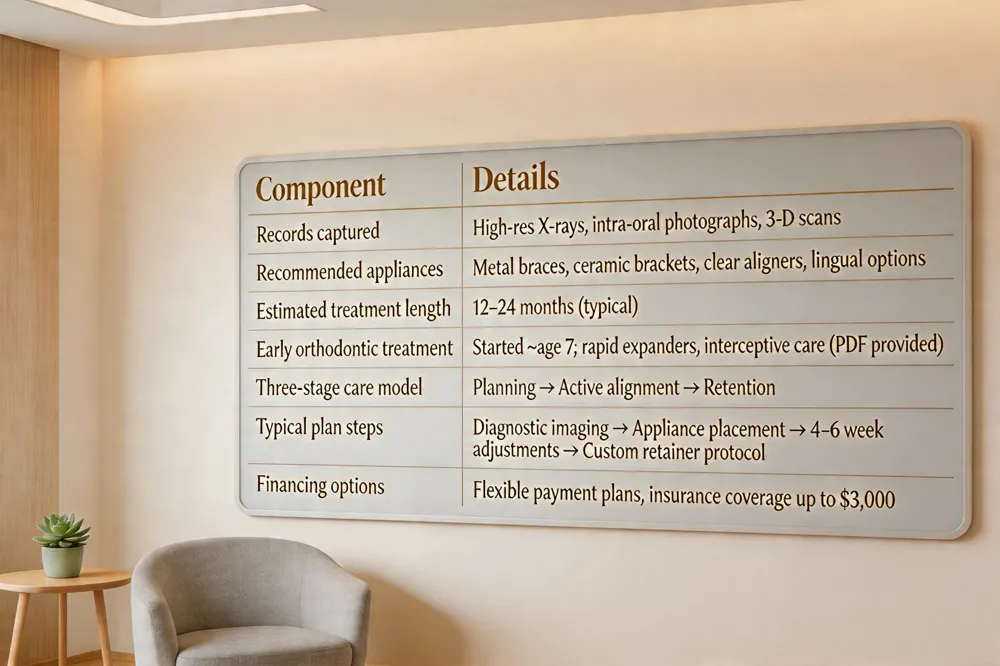 Your first orthodontic appointment at Trielle Orthodontics begins with a friendly introduction, paperwork, and a thorough oral exam. The orthodontist captures digital records — high‑resolution X‑rays, intra‑oral photographs, and 3‑D scans— to assess teeth, jaws, and bite. These images form the basis of a personalized treatment plan that outlines the recommended appliance (metal braces, ceramic brackets, clear aligners, or lingual options), estimated duration (typically 12–24 months), and any pre‑treatments needed. The practice also provides an “[Early Orthodontic Treatment] https://pmc.ncbi.nlm.nih.gov/articles/PMC9191856/)” PDF, which explains why interceptive care is started around age 7, describes common appliances such as rapid expanders, and offers financing tips. In the broader context, orthodontic care follows three stages: planning, active alignment, and retention. A typical plan example includes diagnostic imaging, appliance placement, 4–6‑week adjustments, and a custom retainer protocol. Trielle Orthodontics’ treatment list ranges from traditional braces to Invisalign, self‑ligating and lingual systems, and advanced options like palatal expanders, all supported by modern digital technology and flexible payment plans.
Choosing Between Clear Aligners and Braces
| Factor | Clear Aligners | Braces |
|--------|----------------|--------|
| Visibility | Virtually invisible | Visible (metal/ceramic/lingual) |
| Removability | Yes (for eating, cleaning) | No (fixed) |
| Adjustment frequency | New tray every 1‑2 weeks | Office visit every 4‑8 weeks |
| Typical duration | 6‑18 months (mild‑moderate) | 12‑24 months (complex) |
| Pain level | Mild, short‑lived ache | Soreness after adjustments, possible cheek irritation |
| Compliance needed | 20‑22 hrs wear daily | Oral hygiene & dietary restrictions |
| Cost range | $3,000‑$7,500 (insurance up to $3,000) | $3,000‑$7,500 (similar coverage) |
| Best for | Image‑conscious adults, mild‑to‑moderate cases | Severe crowding, bite issues, complex movements |
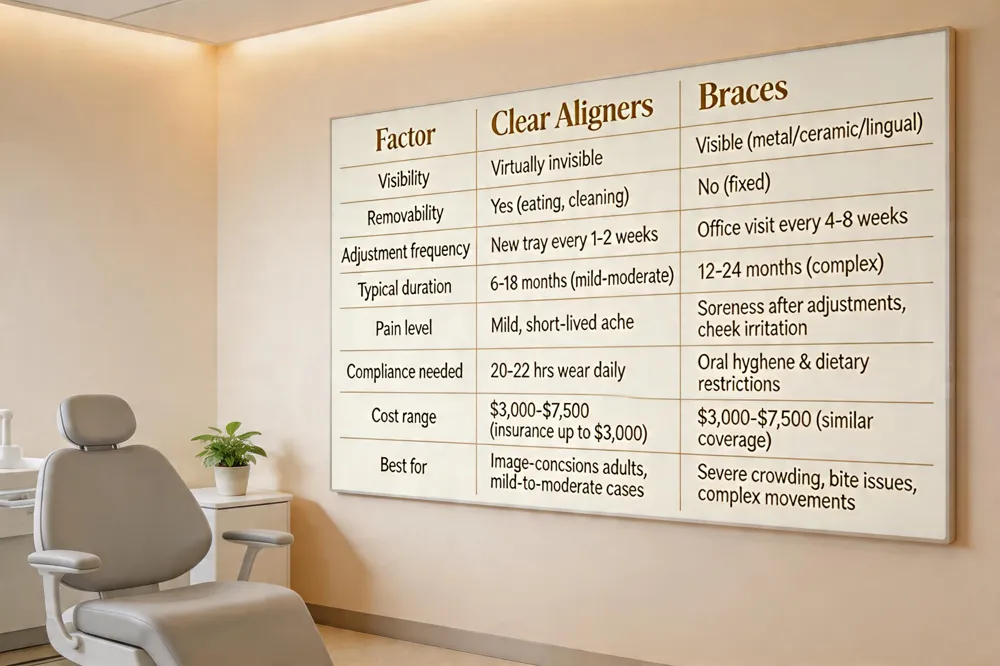 Adults start both clear‑aligner and brace treatment with a comprehensive exam, digital scans, and a customized plan. Braces are fixed and rely on continuous force from brackets and archwires, requiring adjustments every 4‑8 weeks and typically lasting 12‑24 months. Clear aligners are removable, transparent trays changed every 1‑2 weeks; patients wear them 20‑22 hours daily and often finish in 6‑18 months for suitable cases.
Which is better? The “better” option depends on case complexity and lifestyle. Aligners are virtually invisible, removable for eating and oral hygiene, and need fewer office visits—ideal for image‑conscious adults with mild‑to‑moderate mis‑alignments. Braces (metal, ceramic, or lingual) treat a broader range of problems, including severe crowding and bite issues, but are more visible and restrict certain foods.
Pros & cons: Braces excel at complex movements but can cause soft‑tissue irritation and require dietary restrictions. Aligners offer discretion, ease of cleaning, and no food limits, yet demand strict wear compliance and may be less effective for large rotations.
Speed: Aligners often complete treatment faster (average 12‑18 months) than braces (18‑24 months), though speed varies with complexity and compliance.
Pain: Braces may cause soreness after each adjustment and occasional cheek irritation; aligners produce milder, short‑lived ache that can be relieved by removal.
Cost: Both options fall in the $3,000‑$7,500 range, with insurance covering up to $3,000 and flexible financing available at Trielle Orthodontics. The final choice balances aesthetics, comfort, and clinical needs.
Active Treatment: How Appliances Work
| Aspect | Details |
|--------|---------|
| Appliance placement | Brackets bonded + archwire **or** series of custom clear‑aligner trays |
| Adjustment schedule | Every 4‑8 weeks (tighten wires, replace elastics, dispense new aligners) |
| Wire progression | 1️⃣ Flexible NiTi for leveling → 2️⃣ Larger NiTi/Cu‑NiTi for space closure → 3️⃣ Rectangular stainless‑steel or beta‑titanium for torque → 4️⃣ Thin high‑strength stainless‑steel for finishing |
| Compliance importance | Braces: oral hygiene & diet; Aligners: 20‑22 hrs wear daily |
| Common minor issues | Gum irritation, enamel demineralization, root resorption, discomfort, dietary limits |
| Patient tip | You can kiss with Invisalign – it stays securely in place and is virtually invisible |
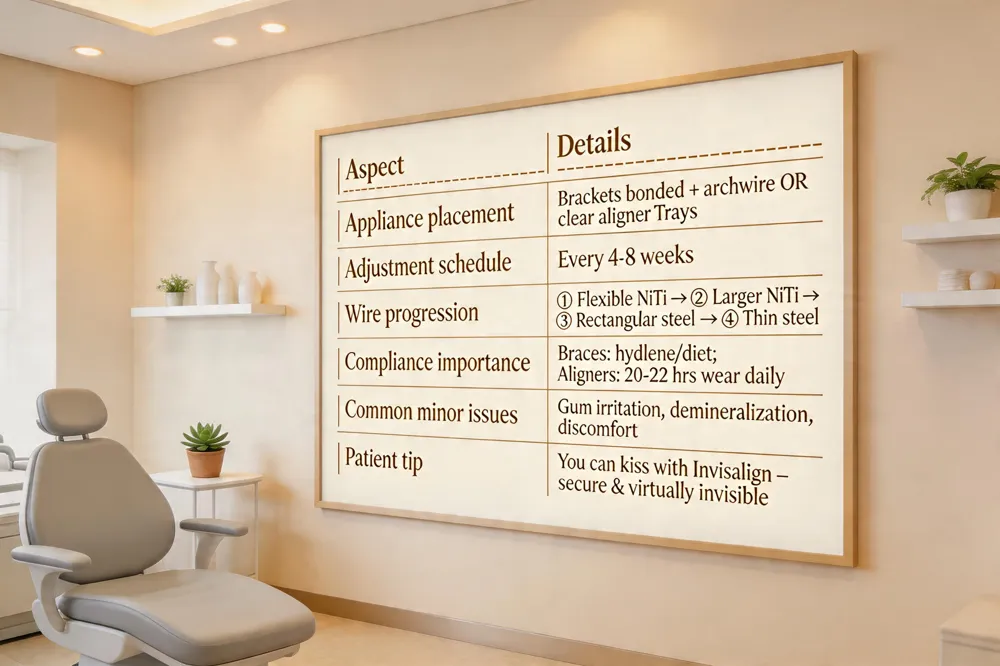 After the initial consultation, the active phase begins with Appliance placement – brackets are bonded to the teeth and an archwire is inserted for braces, or a series of custom clear aligner trays is provided. Orthodontists schedule adjustments every 4 to 8 weeks to tighten wires, replace elastics, or dispense new aligners, ensuring steady tooth movement. Wire phases progress from flexible round nickel‑titanium (NiTi) for initial leveling, to larger NiTi or copper‑NiTi for space closure, then to rectangular stainless‑steel or beta‑titanium for torque control, and finally to a thin, high‑strength stainless‑steel wire for finishing. Compliance is critical: braces require diligent oral hygiene and dietary restrictions, while aligners must be worn 20–22 hours daily and removed only for eating or cleaning. Yes—you can kiss your boyfriend with Invisalign; the aligner stays securely in place and is virtually invisible. Theest and minor orthodontic include such be concerns, drift reduced airway space, gum irritation, enamel demineralization, root resorption, discomfort, dietary limits, and financial or time commitments
Managing Comfort, Hygiene, and Lifestyle
| Topic | Recommendations |
|-------|-----------------|
| Pain after adjustments | Ibuprofen or acetaminophen, salt‑water rinses, orthodontic wax on sore spots |
| Oral hygiene | Brush after every meal with a bristled brush, floss with threaders, use fluoride mouthwash |
| Food restrictions | Avoid sticky (caramel, gum) and hard foods (nuts, popcorn, raw apples); cut crunchy foods into small pieces |
| Protective accessories | Orthodontic wax for brackets, mouthguard during sports |
| Price overview (Trielle) | Braces $2,000‑$6,000, Ceramic $4,000‑$6,500, Aligners $4,000‑$7,000, Lingual $7,000‑$10,000 |
| Financing | Payments can be near $100/month with 24‑month term and modest down payment |
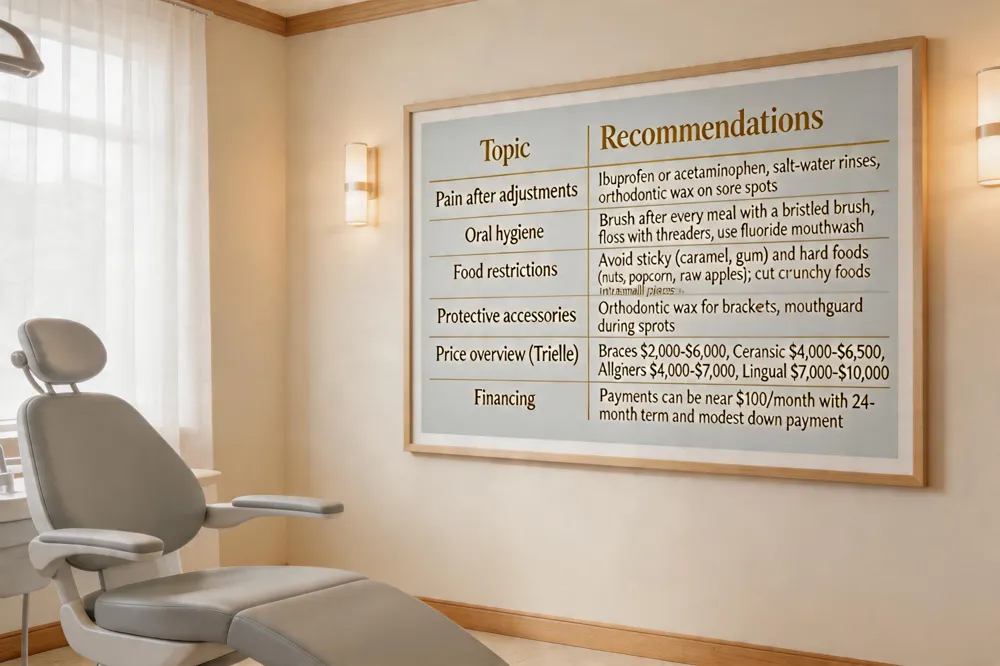 Pain after adjustments is normal; ibuprofen or acetaminophen, salt‑water rinses, and orthodontic wax soothe sore spots.
Restrictions: avoid sticky foods (caramel, gum), hard items (nuts, popcorn, raw apples) and cut crunchy foods into small pieces.
Orthodontic wax covers ends; mouthguard worn during sports protects teeth.
Orthodontic treatment price – At Trielle Orthodontics, braces cost $2,000‑$6,000, ceramic $4,000‑$6,500, clear aligners $4,000‑$7,000, and lingual $7,000‑$10,000; insurance and financing help. Are aligners or braces cheaper? Braces are slightly less expensive, $2,500‑$7,500 vs $3,000‑$8,000 for aligners; case complexity matters. Can you pay $100 a month for braces? Yes—Trielle offers financing with modest down payment and 24 month terms that can keep payments near $100 for braces. Orthodontic treatment plan PDF – Download PDF from our website outlining records, appliances, timeline, costs, options.
Retention and Long‑Term Success
| Retainer type | Wear schedule |
|---------------|----------------|
| Removable clear (Essix/Hawley) | Full‑time initially, then night‑only |
| Fixed bonded retainer | Permanent behind teeth; no removal required |
| Follow‑up visits | Regular appointments during retention to check fit and alignment |
| Oral hygiene during retention | Continue brushing/flossing; avoid hard, sticky, chewy foods |
| Common disadvantages | Gum irritation, enamel demineralization, root resorption, dietary limits, financial/time commitment |
| Cost comparison (Trielle) | Both aligners & braces $3,000‑$7,500 before insurance; similar coverage limits |
| Why some dentists prefer braces | Aligners are removable & require compliance; complex movements (severe rotations, large gaps) harder to achieve |
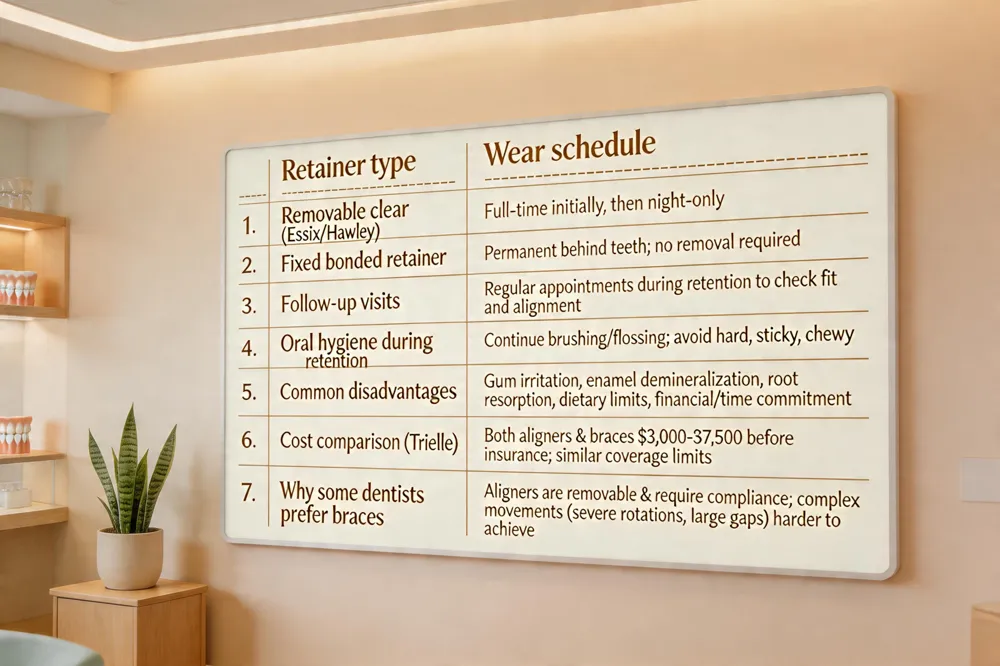 The retention phase begins after active treatment ends, using removable (Essix or Hawley) or fixed retainers to stabilize the new tooth positions.
Options include removable clear retainers (Essix or Hawley) and fixed bonded retainers; the former is worn full‑time initially then night‑only, while the latter stays behind the teeth permanently.
Regular follow‑up visits are scheduled during the retention phase to ensure the retainer fits properly and the teeth remain aligned.
Good oral hygiene and dietary restrictions (avoiding hard, sticky, or chewy foods) are emphasized to protect appliances and promote healthy teeth and gums.
Why don't dentists like Invisalign? Many prefer braces because Clear aligners are removable, virtually invisible trays requiring 20–22 hours of daily wear. non‑compliance risks relapse, and complex movements (severe rotations, large gaps) are harder to achieve. Aligners can also stain or crack, and the cost of a full series may exceed that of fixed appliances.
Orthodontic treatment disadvantages include potential gum irritation, enamel demineralization, root resorption, dietary restrictions, and the financial and time commitment of months‑to‑years of care.
Clear aligners vs braces process cost: Trielle Orthodontics in Union, NJ offers personalized orthodontic care, both options range $3,000–$7,500 before insurance, with similar coverage limits. Aligners are removable and often need fewer office visits, while braces may be chosen for more complex cases.
Conclusion
After reviewing the orthodontic journey—from the initial consultation and diagnostic records, through the placement of braces or clear aligners and regular 4‑8‑week appointments, to the final removal and retention phase—you’ll see how each step builds toward a healthier, straighter smile. At Trielle Orthodontics we are committed to tailoring every phase to your unique anatomy, lifestyle, and goals, using modern digital imaging and flexible financing. Your next move is to schedule the complimentary first visit, discuss your treatment options, and begin the personalized plan that will guide you from start to a lasting, confident smile and enjoy the benefits of improved oral health.