Why Clear Aligners Are Gaining Popularity in Union, NJ
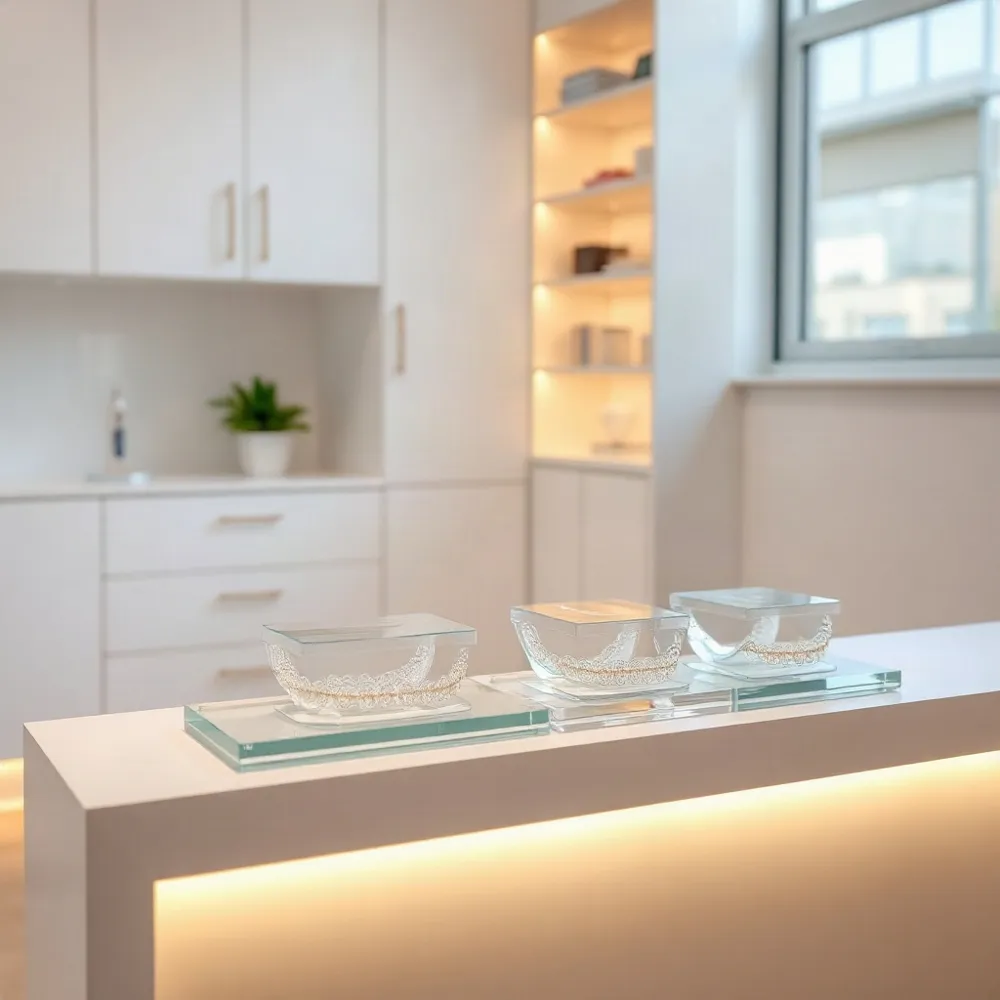
Clear aligners have become a discreet orthodontic option for Union, NJ residents who want a virtually invisible solution. The thin, transparent trays blend seamlessly with the teeth, making them hard to notice even up close. Because they are removable, patients can eat any foods, brush, and floss without restriction, which improves oral hygiene and comfort compared with traditional metal braces. Trielle Orthodontics builds on these advantages with a personalized approach: each patient receives a 3‑D digital scan, a customized treatment plan, and aligner material—whether Invisalign’s SmartTrack® or ClearCorrect’s thinner polymer—chosen to match the case complexity and budget. The practice also offers flexible financing, regular check‑ins, and custom attachments, ensuring a comfortable, tailored experience that fits any lifestyle. With this individualized care, patients achieve their desired smile faster and with confidence.
How the Systems Work and What to Expect
Workflow Overview
| Step | Description | Typical Duration |
|---|---|---|
| Digital Scan / Impression | Intra‑oral scanner captures a 3‑D image (or traditional impression is taken) and sent to the lab. | 1 appointment |
| Custom Aligner Design | Manufacturer creates a series of aligners using proprietary software (ClinCheck® for Invisalign, ClearPilot for ClearCorrect). | 1–2 weeks (lab processing) |
| Wear Schedule | Patients wear each tray 20–22 hours a day, removing only for eating, drinking (non‑water), brushing, and flossing. | Daily |
| Tray Change Frequency | Aligners are typically changed every 1–2 weeks, depending on the treatment plan. | Every 1–2 weeks |
| Attachments & Elastics | Small tooth‑colored bumps (attachments) and/or elastics are added for rotations, extractions, bite corrections. | As prescribed per case |
| Follow‑up Visits | Orthodontist checks progress and may adjust the plan. | Every 4–8 weeks |
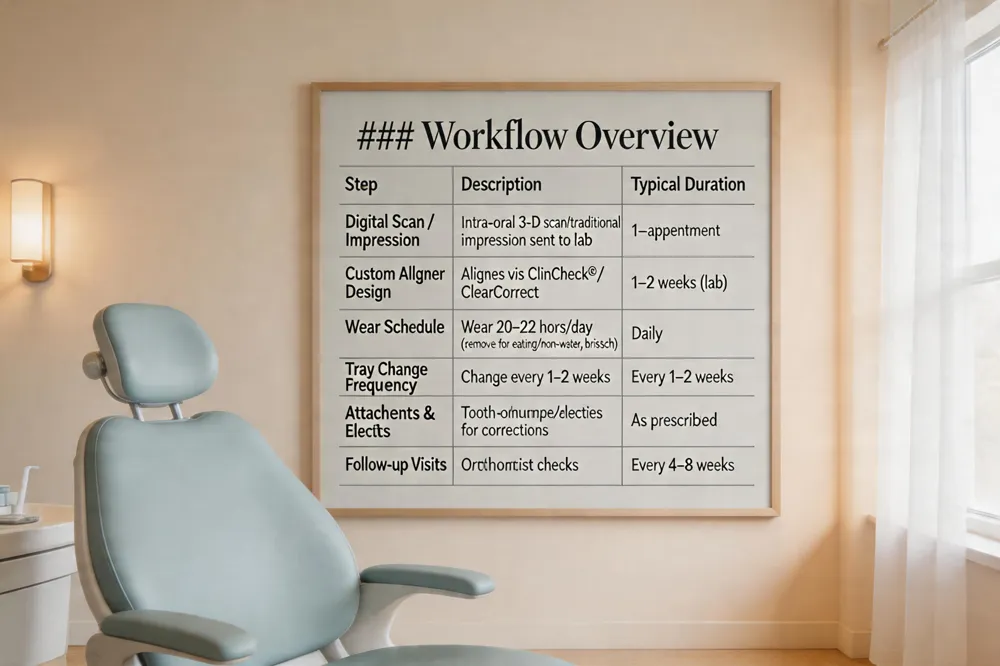 Both Invisalign and ClearCorrect start with a digital scan or traditional impression of your teeth. Using an intra‑oral scanner, the orthodontist captures a 3‑D image that is sent to the manufacturer’s lab, where a custom‑made series of aligners is designed to move each tooth in small, controlled increments. Patients wear each tray for 20–22 hours a day, removing them only for eating, drinking (other than water), brushing and flossing. Aligners are typically changed every 1–2 weeks, depending on the treatment plan and the amount of movement required.
For more complex movements—such as rotating a tooth, closing a large gap, or correcting a bite—both systems can incorporate attachments (small tooth‑colored bumps) and elastics. Attachments provide the clinician with extra points of force application, while elastics help adjust the vertical and horizontal relationships between the upper and lower arches. Invisalign’s digital platform often pre‑plans attachment placement, whereas ClearCorrect allows the provider to customize attachment design directly. Consistent wear and proper use of these auxiliaries are critical for achieving the planned outcome on schedule.
Comfort and Pain: Does ClearCorrect Hurt More Than Invisalign?
Material & Comfort Comparison
| Feature | Invisalign (SmartTrack®) | ClearCorrect (Thin Polyurethane) |
|---|---|---|
| Thickness | Slightly thicker, multi‑layered polymer | Thinner, more flexible plastic |
| Edge Finish | Polished, smooth edge trimmed to gum line | Can have sharper edges, may irritate gingiva |
| Typical Comfort | Generally described as “snug” and comfortable | Described as “lighter” but may cause mild soreness initially |
| Common Irritation | Minimal edge irritation | Possible edge irritation, especially during first few days |
| Patient Preference | Preferred by those seeking smoother feel | May be preferred by patients with very sensitive gums |
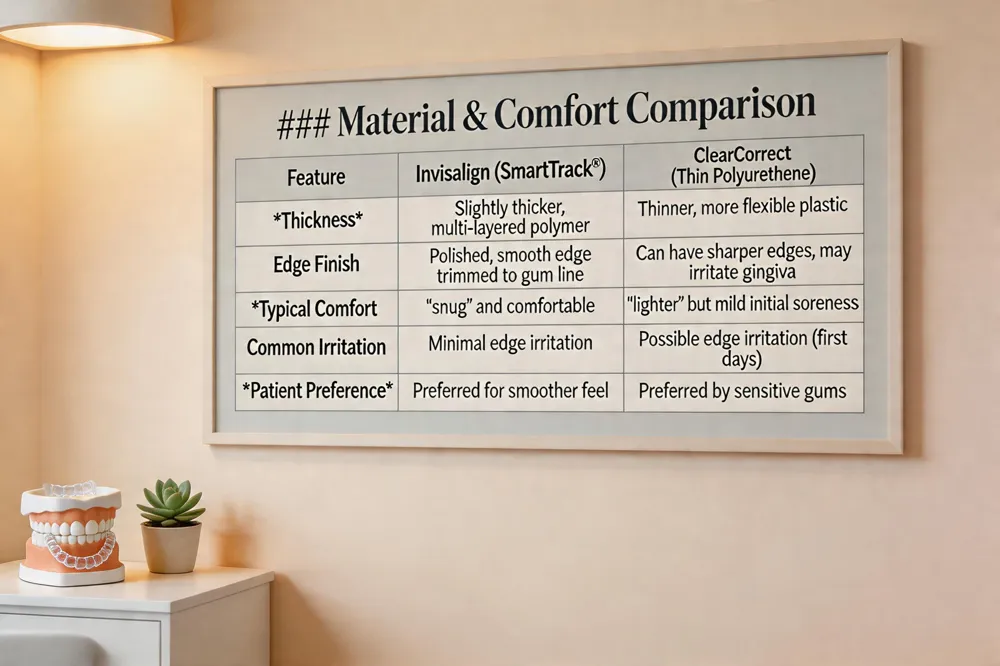 Both Invisalign and ClearCorrect rely on custom‑made, clear plastic trays, but the polymers they use differ.
Invisalign’s aligners are fabricated from the patented SmartTrack® material, a slightly thicker, multi‑layered polymer that is trimmed to the gum line and polished for a smooth edge.
ClearCorrect’s trays are made from a thinner, more flexible plastic that some patients describe as “lighter” in the mouth. Because ClearCorrect’s material is thinner, it can produce sharper edges that may rub against the gingiva, leading to occasional edge irritation or mild soreness, especially during the first few days after a new set is placed.
Invisalign’s thicker, polished SmartTrack® generally provides a snug, comfortable fit that tends to be gentler on soft tissues. Clinical observations and patient surveys consistently show that most users find Invisalign to be a bit more comfortable overall, though individual experiences vary. Patients with very sensitive gums may prefer the thinner profile of ClearCorrect, while others appreciate the smoother feel of Invisalign.
In practice, both systems require diligent 22‑22‑hour daily wear, and proper placement helps minimize discomfort regardless of the material used.
Cost Comparison: Invisalign vs. ClearCorrect
Price Ranges & Tiered Plans
| System | Starting Price | Upper‑End Price | Tiered Plans (examples) |
|---|---|---|---|
| Invisalign | $3,000 | $8,000 | Full (unlimited), Lite (≤14 align),), Express 10, Express55, i7 |
| ClearCorrect | $2,000 | $8,000 | Limited 6, Limited 12, Unlimited |
Both systems may be partially covered by dental insurance (up to ~$3,000) and are eligible for FSA/HSA reimbursement.
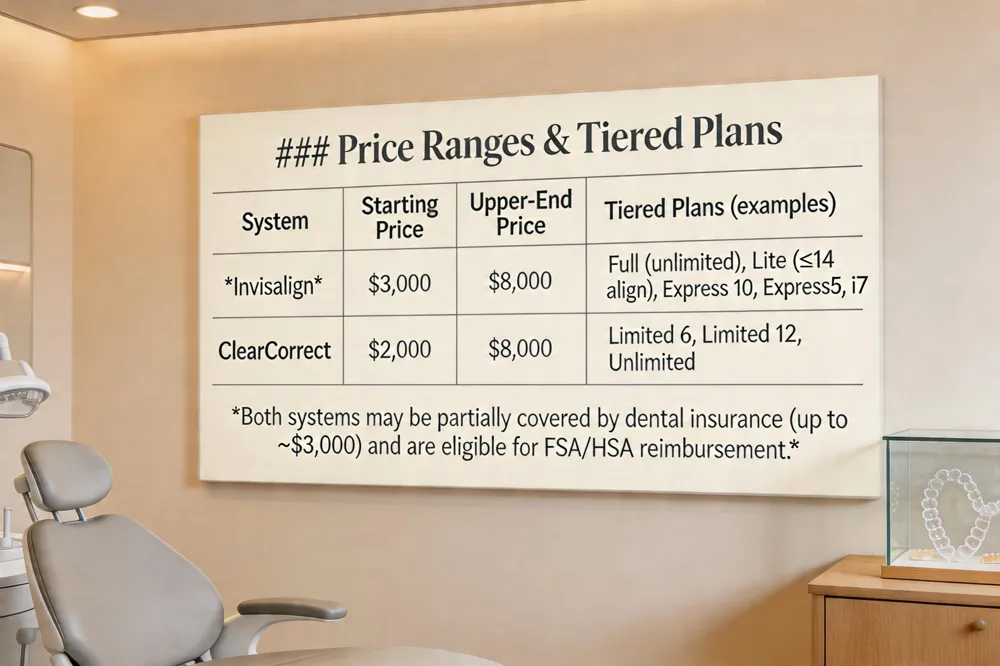 When you compare Invisalign and ClearCorrect, price is often the first factor patients consider. Price ranges vary by case complexity and the number of aligners needed. Invisalign treatments typically start around $3,000 and can rise to $8,000 for more extensive cases, while ClearCorrect usually begins near $2,000 and can also reach up to $8,000 for larger movements. Both brands offer tiered treatment plans—Invisalign provides options such as Full (unlimited aligners), Lite (up to 14 aligners), Express 10, Express 5, and i7, whereas ClearCorrect presents Limited 6, Limited 12, and Unlimited plans. These tiers let the orthodontist match the plan to the severity of the malocclusion, influencing the final cost. Insurance and financing further affect out‑of‑pocket expenses. Many dental insurance policies cover a portion of clear‑aligner therapy, often up to $3,000, and both systems are eligible for FSA/HSA reimbursement. At Trielle Orthodontics in Union, NJ, we work with you to create a personalized payment strategy—whether through interest‑free financing, CareCredit, or seasonal promotions—to ensure the chosen system fits your budget while delivering optimal results.
Treatment Capabilities and Case Complexity
Complexity Capability Matrix
| System | Material | Software | Ideal Case Complexity |
|---|---|---|---|
| Invisalign | SmartTrack® (thicker, patented) | ClinCheck® (advanced 3‑D planning) | Mild → Severe (crowding, deep over‑bite, under‑bite, cross‑bite) |
| ClearCorrect | Thin BPA‑free polyurethane | ClearPilot | Mild → Moderate (most misalignments, limited severe cases) |
| Spark | TruGEN™ (high translucency) | Spark’s digital workflow (similar to ClinCheck) | Mild → Moderate‑Severe (good aesthetics, stain‑resistant) |
| Direct‑to‑Consumer (SmileDirectClub, Byte, Candid) | Basic clear plastic | Limited remote planning | Mild (simple spacing, minor rotations) |
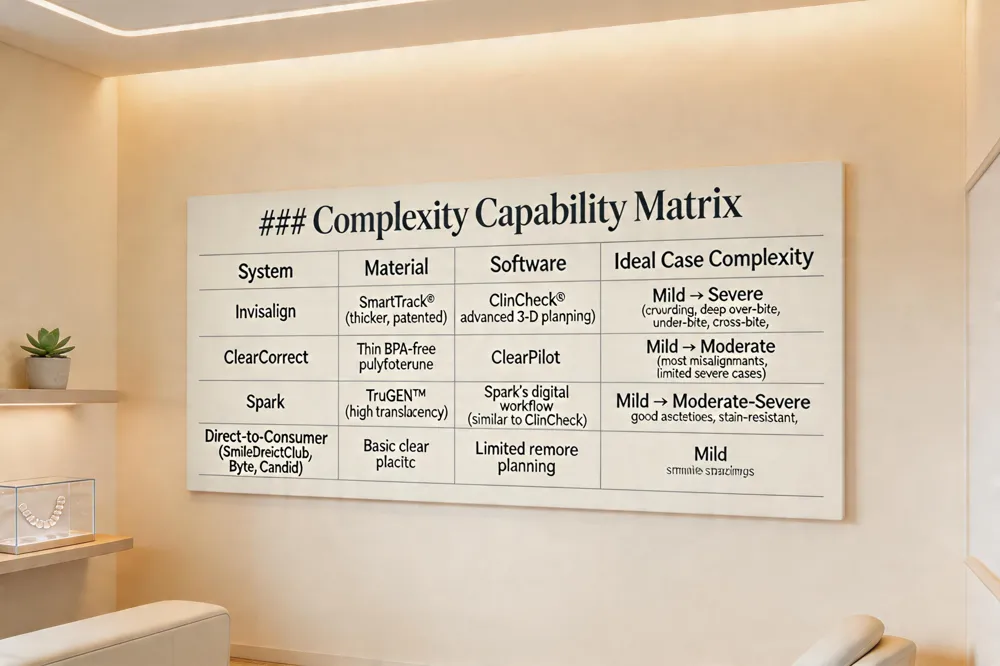 Clear aligners can address a spectrum of malocclusions, from mild to complex cases. Invisalign’s SmartTrack® material and ClinCheck® software enable treatment of severe crowding, deep over‑bites, under‑bites, and cross‑bites, while ClearCorrect’s thinner polyurethane trays are best suited for mild to moderate misalignments, offering three plan levels (Flex, Unlimited, Premium) to match case severity.
Clinical evidence supports comparable outcomes for simple to moderate cases (Kravitz et al., 2009; Djeu et al., 2005), with Invisalign showing a slight advantage in highly complex scenarios due to its extensive attachment library and precision‑cut features. Both systems rely on 3‑D digital scans to map tooth movement, ensuring predictable results when overseen by a qualified orthodontist.
Attachments and elastics are integral for achieving rotations, extrusions, and bite corrections. Invisalign’s digital platform often automates attachment placement, whereas ClearCorrect lets clinicians customize attachment design manually. Elastics can be incorporated in both systems to refine occlusion.
Is Invisalign or ClearCorrect better? The Final Verdict: Both ClearCorrect and Invisalign are great options for clear aligners. The most significant difference is price, but some people may also find ClearCorrect more comfortable. Ultimately, your best choice will depend on your individual needs and preferences.
Best clear aligner system for adults: For adult patients seeking the most reliable, discreet orthodontic solution, Invisalign is widely regarded as the top clear‑aligner system because it combines a proven track record, advanced SmartTrack material, and a fully digital workflow that delivers predictable results. Trielle Orthodontics in Union, NJ offers Invisalign treatment tailored to each adult’s unique bite, lifestyle, and aesthetic goals, ensuring a comfortable fit and faster tooth movement traditional braces. Flexible financing, FSA/HSA options, and insurance coverage make this premium adult orthodontic care affordable for most patients.
Other Clear Aligner Brands and How They Stack Up
Brand Comparison Chart
| Brand | Material | Approx. Price Range | Case Complexity | Notable Features |
|---|---|---|---|---|
| Invisalign | SmartTrack® | $3,000 – $8,000 | Mild to Severe | ClinCheck® planning, extensive attachment library |
| ClearCorrect | Thin BPA‑free plastic | $2,000 – $8,000 | Mild to Moderate | ClearPilot software, lower starting cost |
| Spark | TruGEN™ (stain‑resistant) | Mid‑range (≈$4,000 – $6,500) | Mild to Moderate‑Severe | SmartForce™ attachments, high translucency |
| SmileDirectClub / Byte / Candid | Basic clear plastic | Low (≈$1,500 – $2,500) | Mild | At‑home impressions, minimal office visits, Byte adds HyperByte® vibrational device |
| Traditional Metal Braces | Stainless steel/ceramic brackets & wires | $3,500 – $7,500 | Severe | Visible, frequent adjustments, best for major crowding or bite corrections |
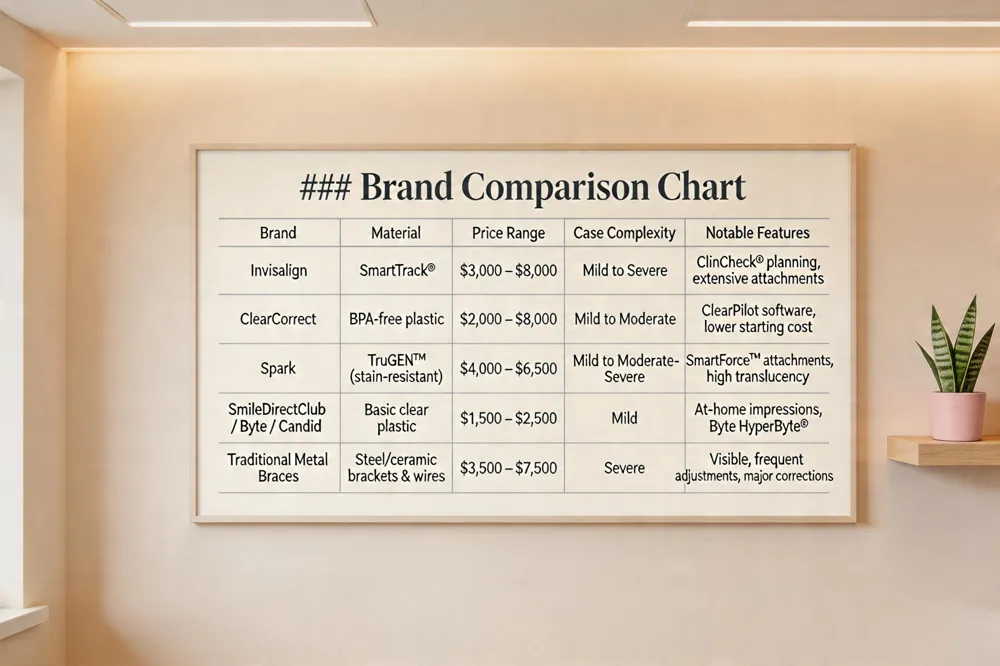 Clear aligner brands extend beyond Invisalign and ClearCorrect, offering a spectrum of price points and supervision models. Direct‑to‑consumer options such as SmileDirectClub, Byte, and Candid let patients take at‑home impressions and receive trays with minimal office visits; Byte adds a vibrating HyperByte® device to accelerate tooth movement, while Candid combines remote monitoring with occasional in‑person check‑ups. These brands are attractive for budget‑conscious patients but lack the extensive attachment libraries and advanced 3‑D treatment visualizations of the leading systems.
Spark aligners, manufactured by Ormco, use TruGEN™ material that boasts high translucency and stain resistance. Spark’s digital workflow—similar to Invisalign’s ClinCheck—allows precise planning and the use of SmartForce™ attachments, making it capable of handling complex cases while delivering a virtually invisible profile.
Clear Aligner Comparison Chart
- Invisalign: SmartTrack™, material, ClinCheck planning, highest price, widest case complexity range.
- ClearCorrect: Thinner BPA‑free plastic, ClearPilot software, lower cost, best for mild‑to‑moderate cases.
- Spark: TruGEN™ material, stain‑resistant, mid‑range price, strong aesthetics, handles complex movements.
- Direct‑to‑Consumer (SmileDirectClub, Byte, Candid): Basic clear plastic, limited attachments, lowest cost, minimal supervision.
- Traditional Metal Braces: Brackets & wires, visible, frequent adjustments, best for severe crowding or major bite corrections.
At Trielle Orthodontics in Union, NJ, we match each patient’s budget, lifestyle, and orthodontic needs to the most suitable system, ensuring comfort, efficiency, and optimal results.
Common Concerns: Pricing Norms and Final Verdict
Pricing Norms & Verdict Summary
| Topic | Details |
|---|---|
| Typical Invisalign Cost (US) | $3,500 – $9,500; $6,000 is average for moderate‑to‑complex cases |
| Typical ClearCorrect Cost | $2,000 – $8,000; lower starting price makes it attractive for mild cases |
| Insurance Coverage | Many dental plans cover up to $3,000; both systems qualify for FSA/HSA |
| Final Verdict | Both systems are effective. Invisalign excels for complex cases and overall comfort; ClearCorrect offers a lighter feel and lower entry cost for simpler cases. Choose based on case complexity, budget, and personal comfort preference. |
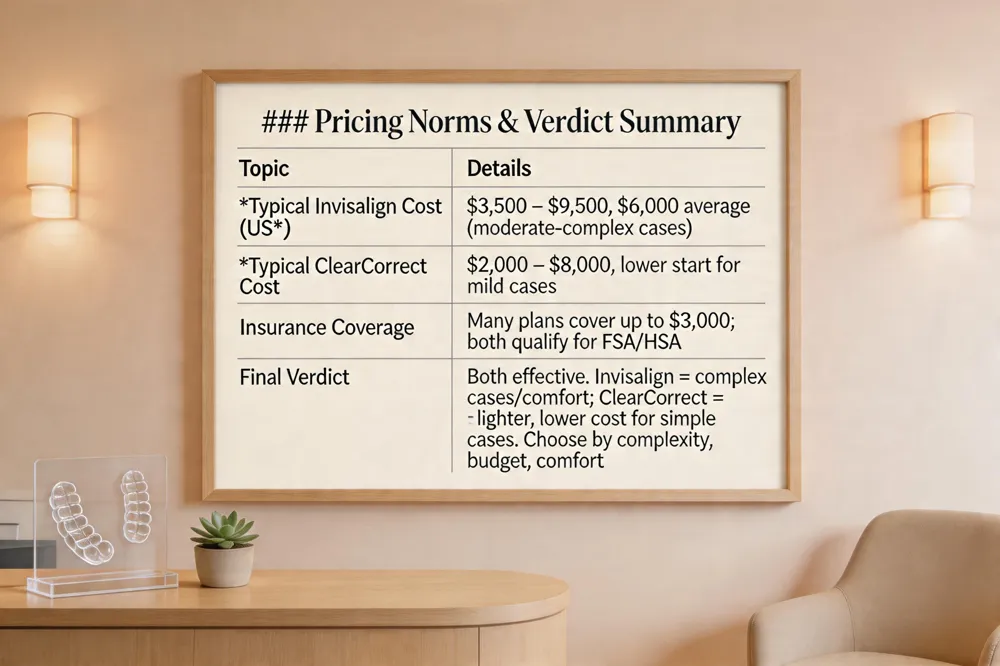 When you hear a $6,000 price tag for Invisalign, it’s natural to wonder if that amount is typical. In the United States, Invisalign treatment generally ranges from $3,500 to $9,500, with $6,000 falling squarely within the average spectrum for moderate to complex cases. Local market factors, case severity, and the specific treatment plan (Full, Lite, Express, etc.) can shift the final cost, but $6,000 is not unusual for a comprehensive Invisalign program in Union, NJ.
Choosing between Invisalign and ClearCorrect hinges on three key decision factors: case complexity, budget, and lifestyle/technology preferences. Invisalign’s SmartTrack® material, extensive attachment library, and robust ClinCheck® digital platform make it especially suited for severe crowding, large bite corrections, and patients who value remote monitoring tools. ClearCorrect, with its thinner, more flexible trays and lower starting price (often $2,000‑$5,000), excels for mild to moderate misalignments and may feel lighter in the mouth.
Patient education is essential. Both systems require 20‑22 hours of daily wear, regular check‑ups (every 4‑8 weeks), and strict compliance to achieve the planned outcome. Understanding the wear schedule, attachment use, and the importance of retainers after active treatment helps set realistic expectations and maximizes the chance of a successful, lasting smile.
Making the Informed Choice
Choosing the right clear‑aligner system begins with a personalized treatment plan that reflects your orthodontic needs, budget, and lifestyle. At Trielle Orthodontics in Union, NJ, our orthodontist uses 3‑D digital scans and ClinCheck‑ClearCorrect Planner software to map each tooth’s movement, allowing us to recommend either Invisalign for complex cases or ClearCorrect for mild‑to‑moderate corrections. Our expertise includes precise attachment placement, elastic integration, and 6‑8‑week check‑ins to ensure the plan stays on track. Ready to start? Schedule a complimentary consultation, where we’ll take a digital impression, discuss financing, and outline the next steps—digital scan, aligner fabrication, and a timeline toward your new smile. Our team also provides instructions and a compliance indicator to help you stay on schedule, results with comfort.