Understanding Orthognathic Needs
Orthognathic surgery, or corrective jaw surgery, repositions the upper (maxillary) and/or lower (mandibular) bone to resolve severe malocclusion, TMJ disorders, sleep‑apnea, or facial asymmetry that braces alone cannot fix. Orthodontics prepares the teeth—usually with braces or clear aligners—so the arches are aligned before the bones are moved; when skeletal discrepancies remain after months of tooth movement, surgery becomes necessary to achieve a stable bite and balanced profile. The typical patient journey spans two to three years: initial orthodontic alignment (12‑18 months), surgical planning with 3‑D imaging and virtual splints, the operation under general anesthesia (1‑4 hours) with a brief hospital stay, followed by a liquid‑to‑soft diet for about a month, gradual return to school or work in 3‑4 weeks, and post‑surgical orthodontic refinement for another 6‑12 months before retention.
Evaluating the Need for Surgical Orthodontics
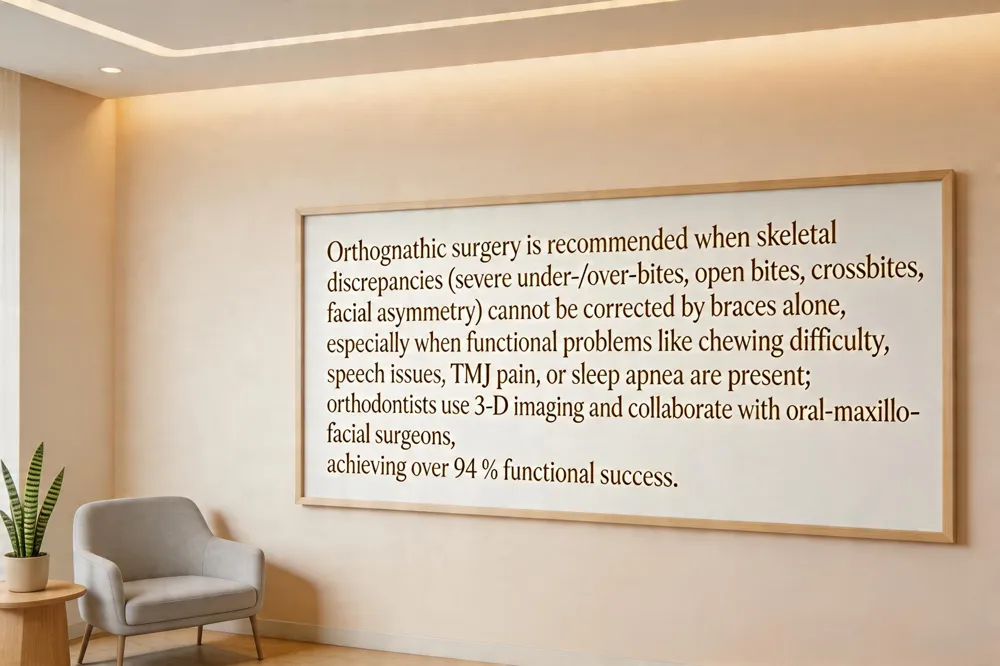 Orthognathic (jaw) surgery is recommended when the skeletal discrepancy is too great for braces alone—such as pronounced underbites, overbites, open bites, severe crossbites, or facial asymmetry that cannot be fully corrected with orthodontic tooth movement. Functional problems that push the decision toward surgery include chronic chewing difficulty, speech impediments, TMJ pain, and obstructive sleep apnea caused by an abnormal jaw position. An orthodontist first aligns the teeth and gathers 3‑D imaging, then works with an oral‑maxillofacial surgeon to evaluate the jaw relationship against normal norms; together they decide if the patient’s bite falls outside the range that can be treated non‑surgically. Jaw surgery is indeed a major, “hard” operation: it involves cutting and repositioning bone under general anesthesia, an overnight hospital stay, and carries higher risks than non‑surgical orthodontics, though modern 3‑D planning and minimally invasive tools have reduced pain and blood loss. Success rates are high—over 94 % of patients report improved function and quality of life, with satisfaction exceeding 90 % in systematic reviews.
Orthodontic Options Before Surgery
 Before referring a patient for orthognathic surgery, an orthodontist first explores non‑surgical bite correction using braces, clear aligners, and elastics to realign the teeth and improve occlusion. TMJ‑focused orthodontic therapy often employs functional appliances, night guards, or splints to reduce joint strain; many TMJ problems linked to malocclusion can be eased without an operation. Underbite and crossbite management may involve reverse‑pull face masks or headgear in growing patients, while adult cases can be treated with coordinated braces and elastics that gradually shift the lower teeth backward or the upper teeth forward.
Can an orthodontist treat TMJ? Yes—by correcting bite misalignment with braces, aligners, or functional appliances, we can alleviate joint pain, clicking, and headaches; severe inflammation may still need a TMJ specialist.
Can orthodontic treatment help with TMJ pain without surgery? Absolutely; aligning the bite reduces uneven pressure on the joint, and appliances such as night guards manage bruxism, offering long‑term relief.
Can orthodontics fix an underbite? In most cases, braces, aligners, and elastics can correct an underbite; severe skeletal discrepancies may require combined surgery and orthodontics.
A surgical referral is considered when orthodontic movement alone cannot achieve functional stability or facial symmetry, or when airway improvement for sleep apnea demands skeletal advancement.
Surgical Procedures and What They Fix
 Maxillary (Le Fort I) osteotomy – The upper jaw is cut and repositioned forward, backward, upward, or downward to correct a maxillary that, vertical excess, or crossbite caused by skeletal misalignment. This restores a proper bite and improves facial balance.
Mandibular (BSSO) osteotomy – The lower jaw is split along the ramus and shifted to treat underbites, overbites, or asymmetry. By advancing or setting back the mandible, the surgeon creates a stable Class I occlusion and eases TMJ strain.
Bimaxillary (double‑jaw) surgery – Both the maxilla and mandible are repositioned in a single operation for complex malocclusions that cannot be resolved by moving one jaw alone. It simultaneously corrects severe overbites, underbites, open bites, and facial asymmetry.
Genioplasty and chin adjustments – Chin bone is reshaped or moved to harmonize the lower facial profile, often combined with other osteotomies for comprehensive aesthetic improvement.
How each procedure addresses specific bite problems – Maxillary cuts fix upper‑jaw discrepancies, mandibular cuts resolve lower‑jaw issues, and bimaxillary surgery aligns both arches for a functional, aesthetic bite. Genioplasty fine‑tunes chin position when facial harmony is desired.
Can jaw surgery fix a crossbite? Yes, when the crossbite stems from skeletal misalignment; surgical repositioning creates a stable bite that braces alone cannot achieve. Trielle Orthodontics tailors plans to each patient’s anatomy.
How painful is jaw realignment surgery? The operation is painless under general anesthesia. Post‑operative soreness peaks in the first 2–3 days and is managed with medication, ice, and a soft diet, subsiding by week 1.
What are the long‑term side effects of jaw surgery? Rarely, patients may have persistent numbness, bite instability, sinus changes, or TMJ issues. Careful planning and ongoing orthodontic follow‑up minimize these risks.
Recovery Timeline and Post‑Operative Care
 Hospital stay and immediate monitoring: Most patients spend 1‑2 days in the hospital after orthognathic surgery, where nurses watch for bleeding, swelling and airway patency while managing pain with medication and ice packs.
Diet progression: The first week is limited to blended liquids or purees; from week 2 to 4 patients transition to soft foods such as scrambled eggs, yogurt and cooked pasta, gradually re‑introducing regular foods as tolerance improves. Post‑operative care includes a liquid or soft diet for about a month.
Swelling control and pain management: Swelling peaks around 48‑72 hours; elevation of the head, cold compresses and prescribed NSAIDs or opioids keep discomfort down.
Speech recovery and jaw mobility: Patients can produce sounds within a few hours after anesthesia, but speech sounds muffled for the first 1‑2 days. Clear conversation typically resumes by the end of week 1, with unrestricted speech returning between weeks 2‑4 as the jaw stabilizes and any elastics or sutures dissolve.
Follow‑up orthodontic appointments: Orthodontic check‑ins occur every 1‑2 weeks during the first month to adjust elastics, monitor tooth movement and ensure proper alignment. These visits continue for several months until final retention.
Overall recovery timeline: Typical recovery timeline: hospital stay of 1‑3 days, liquid diet first week, soft‑food diet weeks 2‑4, light activities by 3‑4 weeks, normal daily life by 6‑8 weeks, and full bone remodeling over 3‑6 months.
Long‑Term Outcomes, Costs and Retention
 Orthognathic surgery boasts a success rate of over 95 % for achieving planned skeletal and functional goals, with patient‑reported satisfaction exceeding 90 % in large studies. Financially can vary: in New Jersey the procedure typically costs $15,000 to $30,000, while higher‑cost markets such as Manhattan range from $20,000 to $40,000. The total includes surgeon fees, anesthesia, facility charges, and post‑operative orthodontic work. Insurance may cover medically necessary cases, and many practices—including Trielle Orthodontics—offer flexible financing. After braces, retention protocols are essential; most patients wear a retainer full‑time initially, then nightly for life, to minimize relapse. Despite diligent retention, teeth can still shift decades later due to natural remodeling, gum health, and habits like grinding. Regular check‑ups allow early detection of late movement and adjustment of the retention plan. Consistent retainer use and good oral hygiene enable most patients to enjoy a stable, beautiful smile for many years after treatment.
Choosing the Right Team in Union, NJ
 Trielle Orthodontics in Union, NJ offers a full spectrum of orthodontic solutions—from clear aligners and traditional braces to adult orthodontics and facial aesthetic treatments. For patients whose bite problems require skeletal correction, the practice works hand‑in‑hand with local oral‑maxillofacial surgeons to create a coordinated orthognathic treatment plan. State‑of‑the‑art 3‑D imaging, cone‑beam CT scans and virtual surgical simulation allow the team to map precise bone cuts, design custom cutting guides and predict post‑surgical facial outcomes with millimeter accuracy. Understanding that jaw surgery can be a significant financial commitment, Trielle provides flexible payment options, financing plans and transparent cost estimates, ensuring every patient receives personalized, patient‑focused care throughout the multi‑year journey.
Your Path to a Balanced Bite and Confident Smile
Orthognathic surgery is recommended when a bite problem is so severe that braces or aligners alone cannot achieve proper alignment. Typical indications include Class II or Class III malocclusions (deep overbite or pronounced underbite), open or cross bites, facial asymmetry, chronic TMJ pain, speech or chewing difficulties, and obstructive sleep apnea caused by skeletal discrepancies. When surgery is combined with orthodontics, the team can first align the teeth, then reposition the jaws, and finally fine‑tune the bite, delivering a stable, functional result and an enhanced facial profile. Trielle Orthodontics in Union, NJ provides comprehensive treatment plans, 3‑D imaging, brace options, and close coordination with oral‑maxillofacial surgeons, ensuring pre‑ and post‑surgical orthodontic care.