Why a Smile Assessment Matters
A smile assessment is a professional, in‑person evaluation performed by an orthodontic specialist to examine oral health, tooth positioning, bite relationship, and facial aesthetics. The exam begins with a medical‑history review, followed by a visual inspection of teeth and gums, digital imaging (X‑rays, intra‑oral photographs, 3‑D scans), bite analysis, and an assessment of gum health and smile‑arc harmony. By documenting these components, the orthodontist can identify crowding, spacing, malocclusions, gum disease, or skeletal issues before treatment begins. This comprehensive data drives a customized treatment plan, predicts duration, prevents complications, and ensures the chosen appliance—whether clear aligners or braces—delivers optimal functional and aesthetic results and long‑term stability for each patient throughout.
The Smile Assessment: From Digital Scans to Personalized Goals
Smile Assessment – Key Steps & Tools
| Step | Description | Primary Tools/Imaging |
|---|---|---|
| 1️⃣ Review History | Collect medical & dental history to identify risk factors | Patient questionnaire, health records |
| 2️⃣ Visual Exam | Examine teeth, gums, facial harmony, and occlusion | In‑office visual inspection |
| 3️⃣ 3‑D Scanning | Generate a precise digital model of the oral cavity | Intra‑oral scanner (e.g., iTero, Trios) |
| 4️⃣ Radiographic Imaging | Detect hidden issues such as bone loss or impactions | Panoramic X‑ray, CBCT if needed |
| 5️⃣ Photographic Record | Document smile aesthetics and facial proportions | High‑resolution intra & extra‑oral photos |
| 6️⃣ Data Integration | Merge scans, X‑rays, and photos into a single 3‑D model | Orthodontic treatment ( (e.g., ClinCheck) |
| 7️⃣ Goal Setting | Define personalized treatment objectives with the patient | Discussion, digital simulation preview |
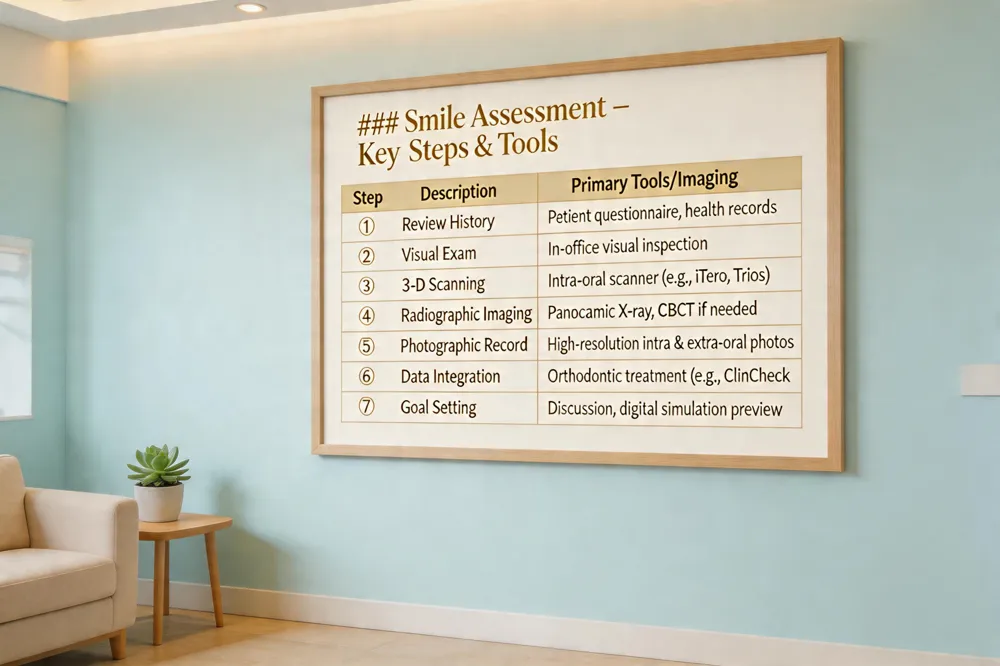 A smile assessment is a comprehensive oral‑health and aesthetic evaluation that serves as the foundation of any orthodontic treatment plan. At Trielle Orthodontics in Union, NJ, the process begins with a review of your medical and dental history, followed by a visual exam of teeth, gums, and facial harmony. Advanced 3‑D imaging, intra‑oral scanners, panoramic X‑rays, and high‑resolution photographs create a precise digital model of your mouth, revealing hidden issues such as gum disease, crowding, or bite misalignment.
What is a smile assessment? A smile assessment is a comprehensive evaluation of your oral health and the aesthetics of your smile. Using advanced imaging and 3‑D scanning, we develop a detailed digital model that guides a customized treatment plan—whether clear aligners, traditional braces, or cosmetic procedures—while honoring your personal goals.
What happens at an orthodontic evaluation? During the first visit, the team checks you in, you meet the doctor, and the orthodontist examines your teeth, explains treatment options, and measures your bite. Patient preferences are discussed to shape the final plan, ensuring comfort, realistic expectations, and a smile that fits your lifestyle.
Building an Orthodontic Treatment Plan: Steps and Phases
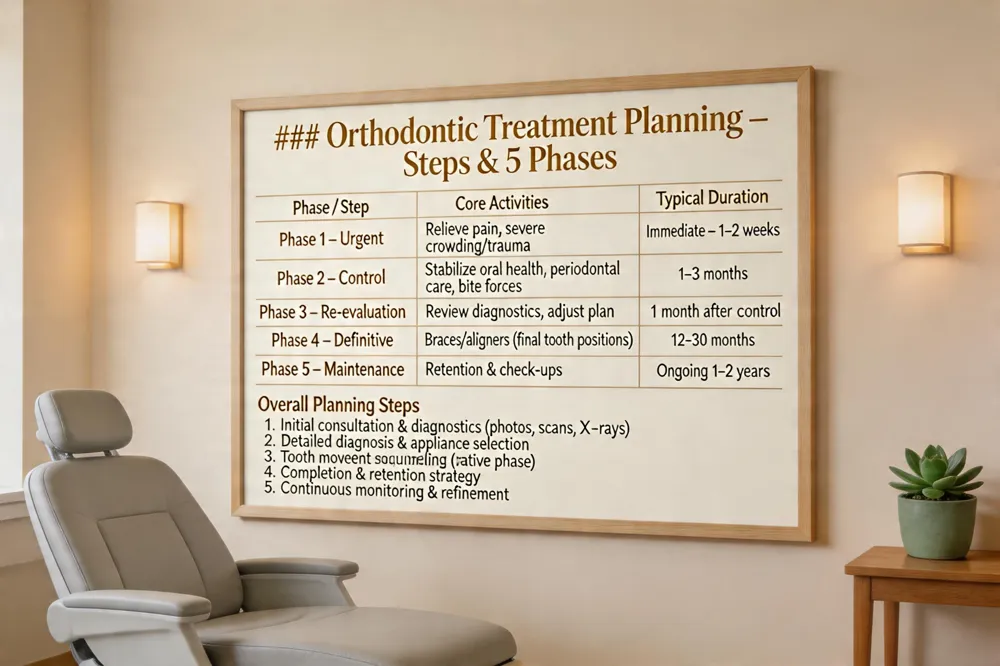
Orthodontic Treatment Planning – Steps & 5 Phases
| Phase / Step | Core Activities | Typical Duration |
|---|---|---|
| Phase 1 – Urgent | Relieve pain, address severe crowding or trauma | Immediate – 1–2 weeks |
| Phase 2 – Control | Stabilize oral health, manage periodontal health, establish bite forces | 1–3 months |
| Phase 3 – Re‑evaluation | Review diagnostics, adjust plan based on early response | 1 month after control phase |
| Phase 4 – Definitive | Execute primary mechanics (braces/aligners) to achieve final tooth positions | 12–30 months (depends on case) |
| Phase 5 – Maintenance | Retention (fixed or removable) and periodic check‑ups | Ongoing – 1–2 years of active retention |
Overall Planning Steps
- Initial consultation & diagnostic records (photos, scans, X‑rays) 2. Detailed diagnosis & appliance selection 3. Sequencing of tooth movements (active phase) 4. Completion & retention strategy 5. Continuous monitoring & refinement
 What is an orthodontic treatment plan?
An orthodontic treatment plan is a personalized roadmap created by an orthodontist to correct a patient’s specific dental and bite issues. It starts with a comprehensive smile assessment—medical history, visual exam, digital X‑rays, intra‑oral scans, and photographs—to diagnose alignment, occlusion, and oral‑health concerns. The orthodontist then selects the optimal appliance (clear aligners, metal or ceramic braces, lingual brackets) and uses 3‑D simulation software to preview results, estimate duration, and outline any pre‑treatments such as extractions.
What is an orthodontic treatment plan?
An orthodontic treatment plan is a personalized roadmap created by an orthodontist to correct a patient’s specific dental and bite issues. It starts with a comprehensive smile assessment—medical history, visual exam, digital X‑rays, intra‑oral scans, and photographs—to diagnose alignment, occlusion, and oral‑health concerns. The orthodontist then selects the optimal appliance (clear aligners, metal or ceramic braces, lingual brackets) and uses 3‑D simulation software to preview results, estimate duration, and outline any pre‑treatments such as extractions.
What are the steps in orthodontic treatment planning?
- Initial consultation & diagnostic records (photos, scans, X‑rays). 2. Detailed diagnosis and selection of appliance. 3. Sequencing of tooth movements (active phase) with regular adjustments or aligner changes. 4. Completion of desired alignment and establishment of a retention strategy (fixed or removable retainers). Throughout, the orthodontist monitors progress and refines the plan.
What are the 5 phases of treatment planning?
- Urgent phase – address pain or severe crowding. 2. Control phase – stabilize oral health and bite forces. 3. Re‑evaluation phase – review diagnostics and adjust the plan. 4. Definitive phase – implement primary mechanics to achieve final tooth positions. 5. Maintenance phase – retainers and periodic check‑ups ensure long‑term stability.
The Dental Team’s Role: Why Assistants Must Master Treatment Planning
Assistant Contributions & Resulting Benefits
| Assistant Contribution | How It Benefits the Practice & Patient |
|---|---|
| Translate smile‑assessment findings into plain language | Reduces patient anxiety, improves understanding |
| Anticipate phase‑specific instruments & materials | Eliminates last‑minute delays, keeps schedule on track |
| Update digital records in real‑time | Ensures accurate data for orthodontist review |
| Coordinate with finance & insurance for treatment roadmap | Enhances transparency, improves satisfaction |
| Identify unexpected findings (e.g., gum disease) early | Allows timely intervention, prevents treatment interruptions |
| Guide patients through retention protocols | Increases long‑term stability and reduces relapse |
 A dental assistant who fully understands the orthodontic treatment‑planning process can act as the bridge between the orthodontist’s diagnostic data and the patient’s expectations. By translating the detailed smile‑assessment findings—medical history, digital 3‑D scans, bite analysis, and aesthetic goals—into clear, jargon‑free explanations, the assistant reduces anxiety and builds confidence. Knowing each phase of the plan (assessment, acute care, disease control, definitive movement, and retention) lets the assistant anticipate the exact instruments, materials, and timing needed for every appointment, from intra‑oral scanning to aligner delivery, which eliminates last‑minute delays. This foresight also supports a seamless workflow: appointments stay on schedule, records are updated in real‑time, and the team can adjust for unexpected findings (e.g., gum disease) before they disrupt treatment. Ultimately, the assistant’s expertise ensures that the patient’s financial roadmap, comfort preferences, and oral‑health status are respected, leading to higher satisfaction, safer procedures, and more efficient operations at practices such as Trielle Orthodontics.
Beyond Braces: Addressing Sleep Apnea and Coding Nuances
Sleep Apnea & Coding Overview
| Topic | Details |
|---|---|
| Orthodontic Role | Use mandibular advancement devices, rapid palatal expanders, or clear‑aligner protocols to enlarge airway space |
| Collaboration | Work with sleep‑medicine specialists for polysomnography and treatment planning |
| Patient Benefits | Improved nasal breathing, reduced apnea events, overall health boost |
| Coding – D8080 | Used for mixed dentition cases where permanent teeth are not fully erupted |
| Coding – D8090 | Applied to patients with fully erupted permanent dentition |
| Decision Factors | Developmental stage, treatment objectives, and specific appliance used |
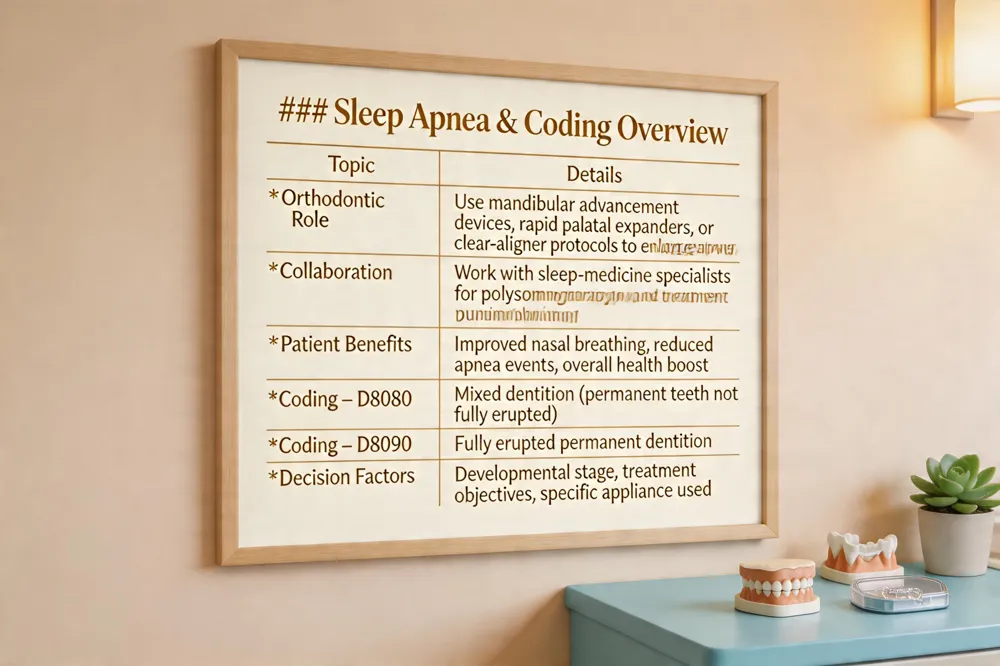 Orthodontists increasingly focus on airway health, using appliances such as mandibular advancement devices, rapid palatal expanders, and clear‑aligner protocols to create more space for the tongue and improve nasal breathing. These interventions are often coordinated with sleep‑medicine specialists, who provide polysomnography results and help determine the severity of obstructive sleep apnea. A collaborative approach ensures that dental alignment and airway function are treated together, delivering a comprehensive health benefit.
Can orthodontists help with sleep apnea? Yes—orthodontists can play a key role in treating certain types of sleep apnea, especially when the condition is linked to structural issues in the jaw or bite. By using appliances such as mandibular advancement devices, clear aligners, or expanders, they can widen the airway and improve breathing during sleep. A thorough evaluation, often in collaboration with a sleep‑medicine specialist, helps determine whether orthodontic intervention is appropriate for your specific case. At Trielle Orthodontics we create individualized treatment plans that address both dental alignment and airway health, using modern technology for comfort and effectiveness. Our flexible payment options and comprehensive patient education ensure you receive the care you need to sleep better and stay healthy.
When to use D8080 vs D8090? D8090 is intended for patients with fully erupted permanent dentition. For mixed dentition, codes such as D8070 or D8080 are more appropriate based on developmental stage and treatment needs.
The Eight Pillars of a Beautiful Smile
The 8 Pillars – Components of a Beautiful Smile
| #: | Pillar | Key Aspect |
|---|---|---|
| 1 | Lip Line | Upper lip aligns with gingival margin of central incisors |
| 2 | Smile Arc | Curvature of incisal edges follows a smooth convex arc |
| 3 | Upper Lip Curvature | Shape of upper lip frames the smile naturally |
| 4 | Lateral Negative Space (Buccal Corridors) | Adequate space prevents “dark‑corner” appearance |
| 5 | Smile Symmetry | Mirror‑image balance of both halves of the smile |
| 6 | Frontal Occlusal Plane | Teeth level with facial midline for harmony |
| 7 | Dental Components | Size, shape, color, and alignment of each tooth |
| 8 | Gingival Components | Healthy, proportionate gingival margins and contour |
 A professional smile assessment begins by evaluating the lip line and smile arc—the vertical amount of tooth visible when you smile and the curvature that follows the incisal edges of the upper front teeth. A harmonious lip line (upper lip reaching the gingival margin of the central incisors) and a smooth, convex smile arc are essential for facial balance.
Next, the upper lip curvature and lateral negative space (buccal corridors) are examined. The lip’s shape frames the smile, while adequate buccal corridors prevent a “dark‑corner” look and enhance the perception of a fuller smile.
Smile symmetry, the frontal occlusal plane, and the dental and gingival components complete the assessment. Symmetry ensures both halves of the smile mirror each other; a level occlusal plane aligns the teeth with the facial midline; and the size, shape, color, and gingival health of each tooth contribute to the final aesthetic.
What are the 8 components of a smile in orthodontics? They are: 1) lip line, 2) smile arc, 3) upper lip curvature, 4) lateral negative space, 5) smile symmetry, 6) frontal occlusal plane, 7) dental components, and 8) gingival components.
Your Path to a Healthier, Confident Smile Starts Here
Your smile assessment is the cornerstone of successful orthodontic care. It lets our orthodontists examine tooth alignment, bite, gum health, and facial harmony, identifying issues such as crowding, bite mis‑alignment, or gum disease before treatment begins. For new patients, the next step is to schedule an in‑person consultation at Trielle Orthodontics in Union, NJ, where we will review your medical history, capture digital scans, X‑rays, and photographs, and discuss personalized treatment options—including clear aligners, braces, or combined approaches. Throughout every visit we prioritize comfort, using state‑of‑the‑art 3D imaging and painless intra‑oral scanners, while offering flexible financing, insurance coordination, and transparent payment plans to make your journey affordable and stress‑free. We support you from start to finish.