Why Zero‑Interest Plans Matter
Zero‑interest orthodontic financing is a payment arrangement in which the total treatment cost is divided into equal monthly installments with no additional charge interest the principal amount. For patients, the main benefit is that the financial barrier to starting treatment is lowered: a modest down payment (often 10‑30 % of the total) spreads the remaining balance over 12‑24 months, making monthly payments comparable to everyday expenses like a coffee habit or a phone plan. This predictability helps families budget more easily and allows early treatment, which can prevent more costly dental problems later. For practices, offering interest‑free plans increases case‑acceptance rates, improves cash flow by securing a committed payment schedule, and differentiates the office in a competitive market. In‑house plans are managed directly by the orthodontist, involve no third‑party fees and flexible credit checks,, third‑party options such as CareCredit provide longer terms and promotional no‑interest periods but may introduce variable rates after the promo ends. Combining both models lets practices tailor solutions to each patient’s needs while keeping the overall cost transparent.
How Zero‑Interest Orthodontic Payment Plans Work
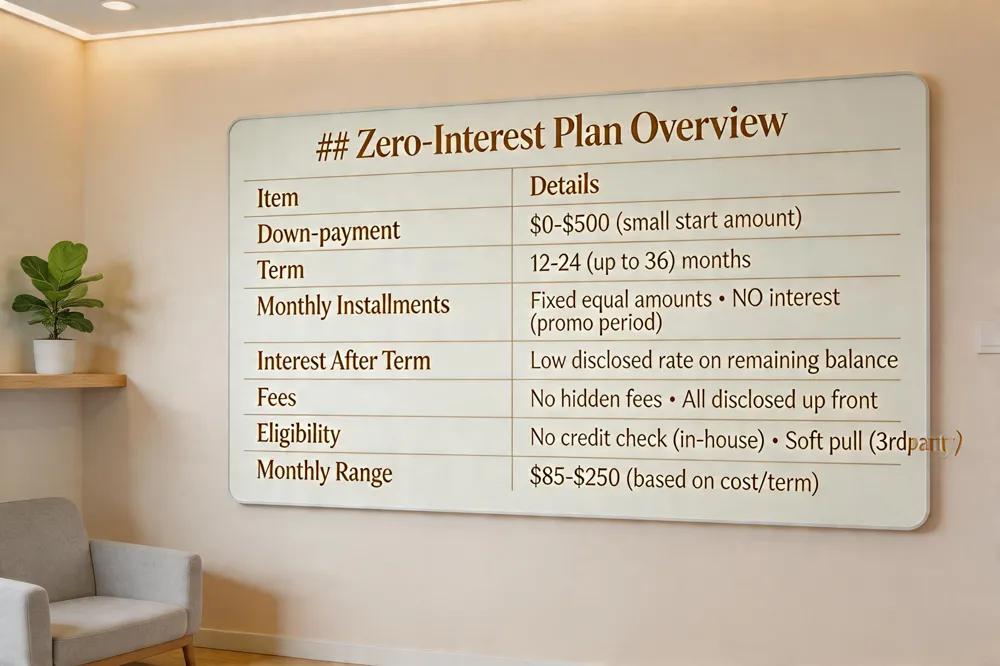
Zero‑Interest Plan Overview
| Item | Details |
|---|---|
| Down‑payment | Small amount (often $0‑$500) to start treatment |
| Term | 12‑24 months (sometimes up to 36 months) |
| **Monthly installments payment | Fixed, equal amounts; no interest during promotional period |
| Interest after term | Low, clearly disclosed rate applied only to any remaining balance |
| Fees | No hidden fees; any administrative fees disclosed up front |
| Eligibility | No credit check for in‑house plan; soft credit pull if third‑party lender used |
| Typical monthly range | $85‑$250 depending on total cost and term |
 Promotional interest‑free periods are common with third‑party lenders such as CareCredit, but Trielle Orthodontics’ in‑house option avoids extra fees entirely. If any balance remains after the zero‑interest term, a low, clearly disclosed interest rate may be applied, and the practice always tells patients this up front.
Legal disclosures require the practice to outline the total cost, payment amounts, and any potential fees or penalties. Trielle Orthodontics follows these rules, providing a transparent contract that lists all treatment components—including consultations, appliances, retainers, and emergency visits—so patients know exactly what they are paying for.
Free zero‑interest payment plans for orthodontic care – how they work
Zero‑interest payment plans at Trielle Orthodontics are set‑up directly by the practice, so no third‑party lender is involved. After a small down‑payment to start treatment, the remaining balance is divided into equal monthly installments that are usually spread over 12 to 24 months. Because the plan is interest‑free, the total amount you pay equals the original cost of the orthodontic care, with no extra fees added during the promotional period. If any balance remains after the zero‑interest term, the practice may apply a low, clearly disclosed interest rate to the remaining amount. The schedule and payment amount can be customized to fit each patient’s budget, making orthodontic treatment more affordable and predictable.
Do payment plans for braces have interest?
Most of Trielle Orthodontics’ in‑house financing options are interest‑free, allowing you to spread the cost of braces over 12‑24 months without extra charges. A small down payment is usually required, and the monthly installments are fixed so you know exactly what you’ll pay. If you choose a third‑party lender instead of the office’s plan, interest may be applied after any promotional period, and rates can vary based on credit approval. The practice always discloses any interest terms up front so there are no hidden fees. This flexible approach lets you focus on treatment while keeping the financial side clear and affordable.
Zero‑interest orthodontic payment plans in New Jersey
Trielle Orthodontics in Union, NJ offers a zero‑interest financing option that lets patients spread the cost of treatment over the first year without any extra fees. This interest‑free plan can be combined with a down payment or used as a no‑down‑payment arrangement, giving families flexible monthly installments that fit their budget. The practice uses modern digital payment platforms that require no hard credit checks, ensuring a quick and hassle‑free approval process. By eliminating interest charges, Trielle Orthodontics helps patients avoid the $500‑plus extra cost that traditional loans can add to orthodontic care. The zero‑interest option is part of their broader commitment to affordable, personalized orthodontic treatment for both children and adults throughout New Jersey.
Financing Without a Credit Check and Options for Bad Credit
Credit‑Friendly Lender Options
| Lender | Credit Check | Max Term | APR (promo) | Notes |
|---|---|---|---|---|
| CareCredit | Soft pull | 6‑12 mo promo, then up to 36 mo | 0 % promo, then 12‑30 % | Widely accepted, no hard pull for promo |
| Cherry | Soft pull (or no credit check) | Up to 60 mo | 0 % promo for many applicants | Flexible for bad credit, can combine with HSAs/FSAs |
| Sunbit | No credit check (income verification) | 3‑36 mo | 0 % promo, then 8‑20 % | Quick approval, ideal for low‑credit patients |
| LendingClub | Soft pull | 12‑24 mo | 0 % promo, then fixed rate | Third‑party loan, may require some credit history |
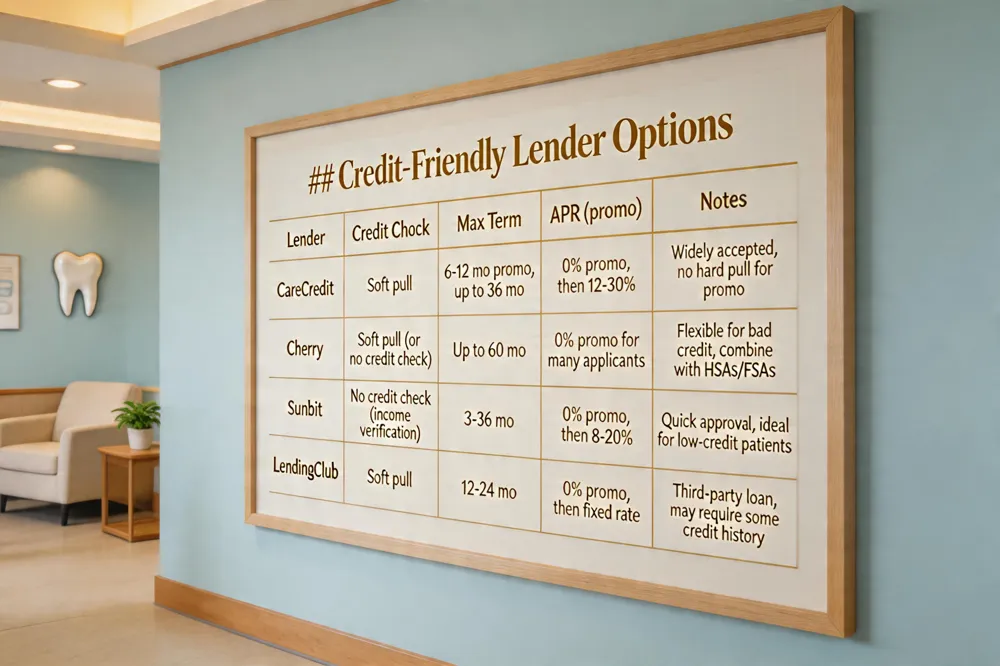 For those who prefer a third‑party lender, options such as CareCredit and Cherry are available. CareCredit offers promotional zero‑interest periods (6‑12 months) after a soft credit pull, while Cherry can extend up to 60 months with 0 % APR for many applicants. Both lenders provide quick decisions and can be combined with insurance benefits, HSAs, or FSAs to further lower out‑of‑pocket costs.
In summary, whether you search for "Braces payment plan no credit check," "Financing for braces with bad credit," or "In‑house financing braces near me," Trielle Orthodontics and its partner lenders deliver flexible, credit‑friendly solutions that fit a variety of budgets and credit situations.
Upfront Payment vs. Financing: Which Is Better?
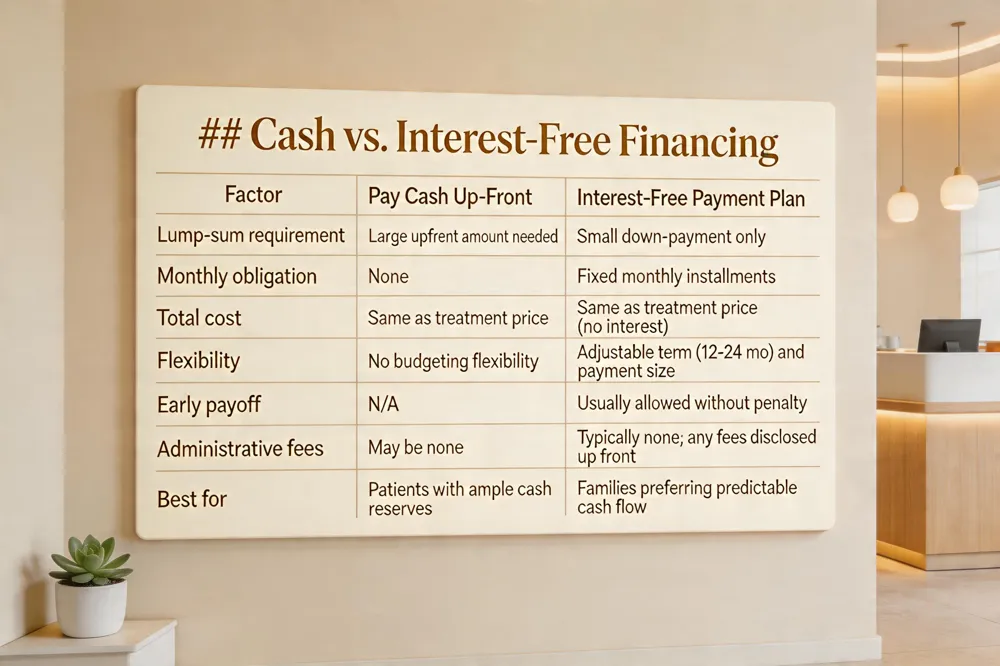
Cash vs. Interest‑Free Financing
| Factor | Pay Cash Up‑Front | Interest‑Free Payment Plan |
|---|---|---|
| Lump‑sum requirement | Large upfront amount needed | Small down‑payment only |
| Monthly obligation | None | Fixed monthly installments |
| Total cost | Same as treatment price | Same as treatment price (no interest) |
| Flexibility | No budgeting flexibility | Adjustable term (12‑24 mo) and payment size |
| Early payoff | N/A | Usually allowed without penalty |
| Administrative fees | May be none | Typically none; any fees disclosed up front |
| BestBest for** | Patients with ample cash reserves | Families preferring predictable cash flow |
 Pros and cons of paying cash
Paying the full amount up front eliminates any administrative fees that some financing companies charge and avoids monthly obligations. However, it requires a large lump sum that many families find difficult to allocate, and it forfeits the budgeting flexibility that a payment plan offers.
Pros and cons of paying cash
Paying the full amount up front eliminates any administrative fees that some financing companies charge and avoids monthly obligations. However, it requires a large lump sum that many families find difficult to allocate, and it forfeits the budgeting flexibility that a payment plan offers.
Benefits of interest‑free payment plans Trielle Orthodontics provides in‑house, zero‑interest plans over 12‑24 months with a modest down payment. Because the practice manages the financing directly, there are no third‑party interest charges, and patients can often pay off early without penalty. The total cost remains the same as the cash price, making it a budget‑friendly way to start treatment immediately.
Impact on overall cost Both cash and interest‑free plans keep the treatment price identical; the difference lies in cash flow. For those with available cash, paying up front avoids any administrative fees. For most families, a flexible, interest‑free plan spreads the expense without increasing the overall amount.
Is it worth it to pay for braces upfront or use a payment plan? If you have the cash and want to avoid monthly payments, paying up front works. Otherwise, Trielle Orthodontics’s interest‑free plan offers the same total cost with manageable monthly payments and early‑payoff flexibility.
Is $10,000 too much for braces? $10,000 is at the high end of the U.S. range, reflecting premium options such as lingual braces or extensive adult treatment. Trielle Orthodontics provides a free consultation to determine if such a cost is justified for your specific case and offers transparent, personalized estimates.
Insurance, Monthly Payments, and Typical Costs
Insurance & Monthly Payments
| Scenario | Total cost | Insurance paid | Remaining balance | Example monthly payment (24 mo) |
|---|---|---|---|---|
| Standard metal braces | $6,000 | $4,000 (≈66 %) | $2,000 | $85‑$100 |
| Ceramic/clear aligners | $7,500 | $3,750 (≈50 %) | $3,750 | $150‑$180 |
| Lingual braces | $10,000 | $5,000 (≈50 %) | $5,000 | $210‑$250 |
| No insurance (full price) | $8,000 | $0 | $8,000 | $330‑$400 (24 mo) |
All plans are 0 % interest during the promotional period; any remaining balance after the term may incur a low disclosed rate.
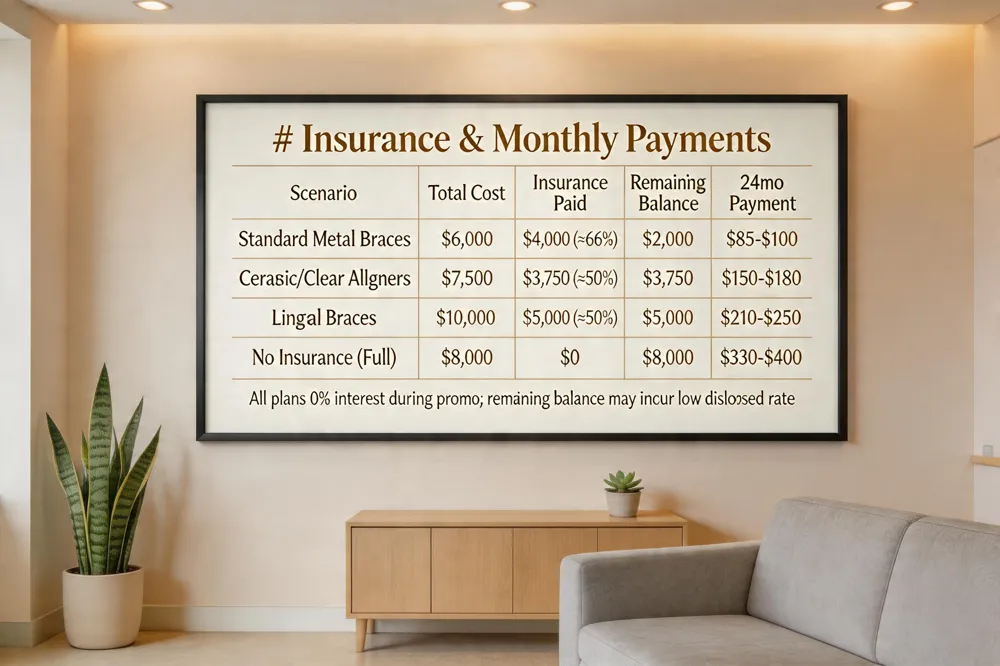 Trielle Orthodontics works with most U.S. dental insurance plans, which typically cover 25‑50 % of the orthodontic fee up to a lifetime maximum. After the insurer’s contribution, the remaining balance can be financed through an interest‑free in‑house plan or a zero‑interest third‑party option such as CareCredit.
Monthly payment for braces with insurance – For a $6,000 treatment where insurance pays $4,000, the $2,000 balance can be spread over 24 months, resulting in payments of roughly $85‑$100 per month. Our 0 %‑interest plans start at $89 per month for 24 months for eligible patients, and FSA/HSA funds can be applied to further reduce out‑of‑pocket costs.
Usual monthly payment for braces – Most patients see monthly amounts between $100 and $250, depending on the appliance (metal $80‑$250, ceramic/clear‑aligner $100‑$300, lingual $200‑$450) and treatment length (often 18‑24 months).
Can you pay $100 a month for braces? – Yes. By selecting a modest down‑payment, leveraging insurance benefits, and choosing a 18‑24‑month repayment term, metal braces or clear aligners can be structured to fall within the $100‑$125 per‑month range. Our team tailors each plan so treatment can begin without a large upfront expense.
Financing for Adults and Flexible Payment Policies
Adult Financing Options
| Option | Down‑payment | Term | Interest | Key Features |
|---|---|---|---|---|
| In‑house zero‑interest | $0‑$500 | 12‑24 mo | 0 % (promo) | No hard credit check, early payoff allowed |
| CareCredit (adult) | $0‑$500 | 12‑36 mo | 0 % promo, then 12‑30 % | Soft pull, can combine with insurance |
| Cherry (adult) | $0‑$500 | 12‑60 mo | 0 % promo for many | Bad‑credit friendly, flexible terms |
| LendingClub (adult) | $500‑$1,000 | 12‑24 mo | Fixed rate after promo | Requires some credit history |
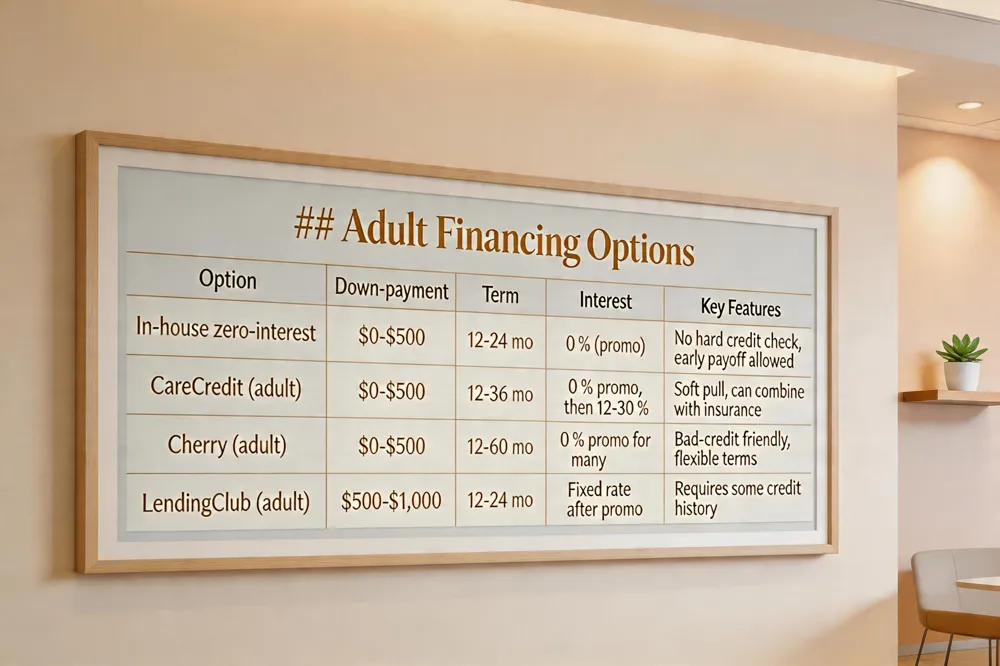 Adult orthodontic financing is now widely available.
Many offices—including Trielle Orthodontics—offer in‑house zero‑interest plans that start with a modest down payment and spread the balance over 12‑ to 24‑month installments.
For longer terms or patients who need larger loan amounts, third‑party lenders such as CareCredit, Cherry or LendingClub provide promotional zero‑interest periods and fixed‑rate options, often with soft credit checks.
Patients can also tap tax‑advantaged accounts. HSAs and FSAs allow pre‑tax dollars to cover part or all of the treatment cost, further lowering out‑of‑pocket expenses.
Do orthodontists accept payment plans? Yes—most orthodontists, including Trielle, provide in‑house financing and partner with lenders to give families predictable monthly payments without high interest.
How does orthodontic financing work for adults? After a down payment, adults choose a 12‑ to 24‑month interest‑free schedule, or a longer third‑party plan with promotional rates, applying insurance, HSAs/FSAs, and discounts first.
Payment plan for braces without insurance? Trielle offers customized no‑interest in‑house plans (12‑24 months) and third‑party options (CareCredit, LendingClub) that can be combined with HSA/FSA funds to cover the full cost without insurance.
Key Takeaways and Next Steps
Quick Checklist
| Step | Action |
|---|---|
| 1. Consultation | Schedule a free, at Trielle Orthodontics |
| 2. Get estimate | Receive itemized treatment cost (consultation, appliances, retainers, emergencies) |
| 3. Choose financing | In‑house zero‑interest or third‑party lender (CareCredit, Cherry, Sunbit) |
| 4. Review terms | Verify down‑payment, term length, any post‑promo interest, and fees |
| 5. Apply | Soft credit pull or no credit check; provide down‑payment |
| 6. Set up payments | Automatic monthly debits; early payoff allowed without penalty |
| 7. Use tax‑advantaged accounts | Apply HSA/FSA funds to lower out‑of‑pocket cost |
| 8. Start treatment | Begin orthodontic care once financing is active |
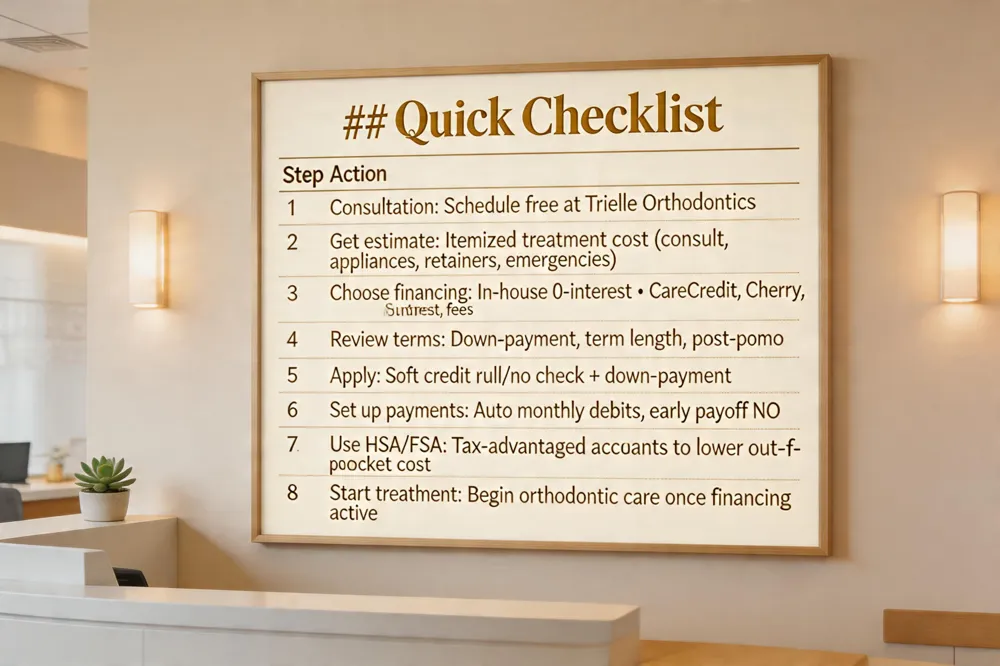 Zero‑interest orthodontic payment plans let families spread the full cost of braces or clear aligners over 12‑24 months (or up to 36 months in some offices) without paying any interest. At practices such as Trielle Orthodontics, a modest down payment is required and the remaining balance is split into equal monthly installments that stay the same for the life of the plan. To start the financing process, schedule a complimentary consultation, ask the staff for a detailed, itemized treatment estimate, and discuss the available in‑house or third‑party options (e.g., CareCredit, Cherry, Sunbit). The office will walk you through the application—often a soft credit pull or no credit check—collect a down payment, and set up automatic monthly debits. For further information, review the AAO’s Gifted Smiles Program, check your HSA/FSA balance, and visit Trielle’s website or call the office for FAQs on zero‑interest financing.
Making a Confident Choice for Your Smile
Zero‑interest orthodontic financing has become a cornerstone of affordable care across the United States. Most practices, including AAO‑member offices, offer in‑house plans that require a modest down payment and spread the remaining balance over 12‑24 months with no added interest. Third‑party providers such as CareCredit or Cherry also deliver promotional interest‑free periods, while hybrid solutions blend both approaches for larger cases. Trielle Orthodontics takes this model a step further by customizing each plan to a patient’s budget, credit profile, and treatment timeline. The practice can start with as little as 10‑30 % down, then set equal monthly installments that match everyday expenses like a coffee habit or a phone bill. All services—consultations, appliances, adjustments, retainers and emergency visits—are bundled into the agreed price, and patients can use HSAs or FSAs to lower out‑of‑pocket costs. To see how these options fit your unique needs, schedule a free consultation at Trielle Orthodontics today.